

in Indian Workforce.
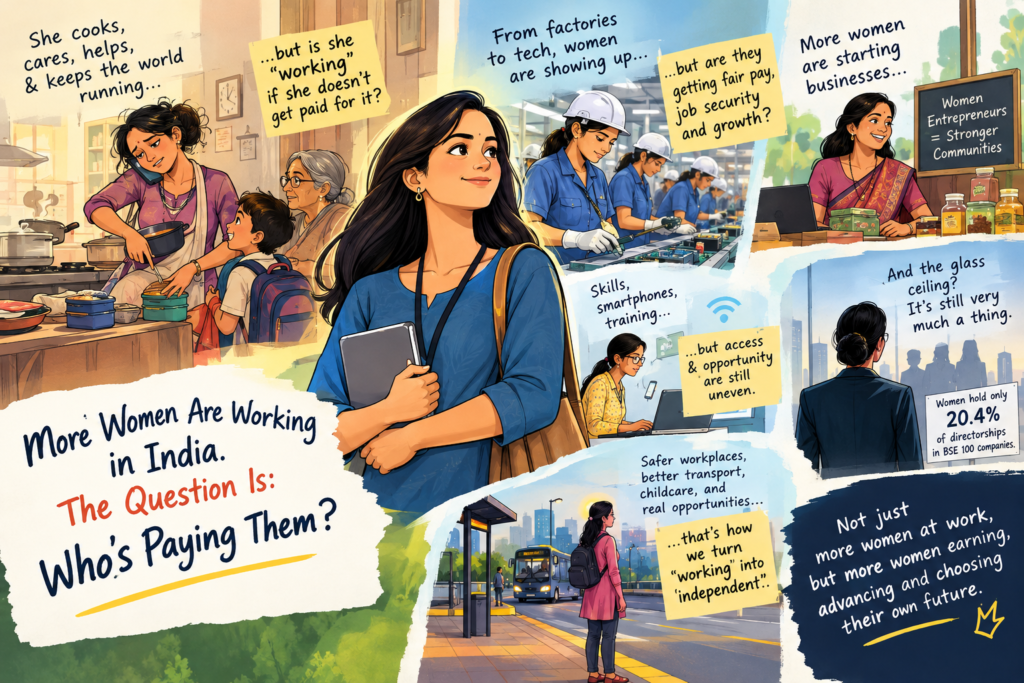
India’s Women Are Working. The Question Is: Who’s Paying Them?
On unpaid labour, workplace barriers, and the curious Indian habit of celebrating women’s empowerment while expecting them to finish the dishes first.
Imagine a woman named Sunita. She wakes up at 5 a.m., prepares breakfast, packs lunchboxes, sends the children to school, looks after an elderly family member, and then spends the morning helping on the family farm. By evening, she is back in the kitchen.
Now imagine someone conducting a survey and asking Sunita, “Do you work?”
She might pause. She might even laugh.
Because in her world, work is everything she does. Yet some of her hardest-working hours may never bring her an independent salary.
Sunita is an illustrative character, but the contradiction she represents is very real.
India’s debate on women’s employment is often reduced to a single question: How many women are working? A more revealing question would be: How many are earning independently, controlling their income, and building careers they can actually sustain?
The distinction matters in a country where nearly half the population is under 29 and women’s participation could make a substantial difference to economic growth.
The good news comes with a footnote
There is genuine progress to report.
According to the PLFS Annual Report 2025, India had an estimated 20 crore employed women aged 15 and above. The female labour force participation rate stood at 40%, while the worker population ratio was 38.8%, measured under the usual-status approach.
Women are also entering formal employment. During 2024–25, the Employees’ Provident Fund Organisation recorded 26.9 lakh net additions of female subscribers. Women are starting businesses, joining apprenticeships, and entering industries once dominated by men.
In mobile-phone manufacturing, women accounted for nearly 70% of the direct workforce, according to a July 2026 assessment by the Ministry of Electronics and Information Technology. Even welding is opening up. Tata Motors’ Jamshedpur facility welcomed its first batch of 27 women welders in 2026.
This is worth celebrating. The image of a woman working with industrial machinery is a welcome change from the outdated assumption that certain jobs come with an invisible “men only” sign.
But progress has a footnote.
Getting women into employment is one achievement. Ensuring that the employment pays fairly, provides security, and leads somewhere is another.
After all, a job title can look impressive on paper. It is less impressive when the salary is irregular, the commute is unsafe, and the promotion seems to be permanently under consideration.

The Family Business: Where Everyone Works, but Not Everyone Gets Paid
In many Indian families, the family business runs on a revolutionary economic model: everyone is an employee, nobody is on the payroll, and the HR department is usually called “Mummy.”
The father manages the shop. The son handles accounts. The daughter answers customer calls, manages social media, and occasionally becomes the unpaid graphic designer. The mother keeps the household running, makes tea for customers, arranges stock, and somehow remembers everyone’s lunch preferences.
At the end of the month, the son might receive a salary. The daughter gets a compliment. The mother gets told that she “doesn’t work outside.”
Apparently, work becomes work only when someone transfers money into your bank account.
But here is the uncomfortable question: If everyone contributes to the family business, why doesn’t everyone get paid?
The answer is not always exploitation in the obvious sense. Family businesses often operate through shared ownership, mutual support, and the expectation that everyone will benefit eventually. Some family members genuinely prefer to reinvest profits rather than draw salaries. Others may receive income indirectly through household expenses or future inheritance.
The problem begins when shared family prosperity becomes an excuse for unequal recognition. A daughter may spend hours managing orders without knowing the business’s profits. A wife may help run a shop for years without having her name on the ownership documents. A mother may handle the accounts so efficiently that nobody notices she is doing the work of an accountant.
And because everyone is family, asking for payment can sound suspiciously like asking for rent from your own relatives.
“Why are you asking for a salary? This is your own business!”
Exactly. Then why is the ownership not mine, the profit-sharing not mine, and the decision-making not mine?
Family affection is not a payment system. If a person contributes regular labour, there should be clarity about whether that contribution is paid employment, shared ownership, or a genuinely voluntary arrangement. Each is legitimate when understood and agreed upon. None should be imposed through guilt.
The real measure of a family business is not simply how much money it earns. It is whether the people who help create that wealth have a fair share of its benefits, a voice in its decisions, and some financial independence of their own.
Otherwise, the business may be thriving while some of its most hardworking employees remain financially invisible.
And that raises one final question: If a business cannot afford to recognise the work of its own family members, is it really profitable—or is part of its profit coming from labour it has simply chosen not to count?